Dana Hansen · 6 November 2026
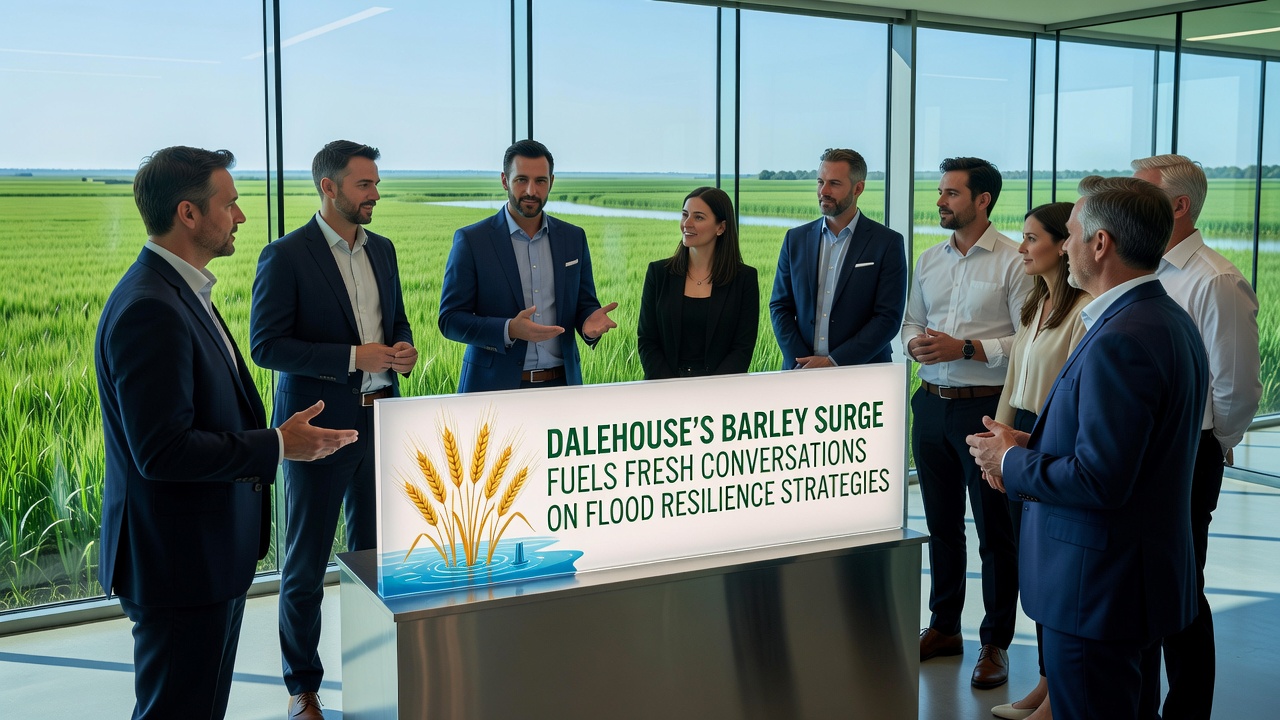
Dalehouse's Barley Surge Fuels Fresh Conversations on Flood Resilience Strategies
Barley production in Dalehouse has risen sharply over the past two seasons, and this increase has prompted local authorities along with agricultural groups to revisit flood resilience measures that protect both crops and surrounding communities. Data from the 2025 harvest season indicated yields climbed by 18 percent compared with 2023 figures, according to regional farming records compiled by the Dalehouse Agricultural Cooperative. Observers note the expansion coincides with shifts in planting patterns on lower-lying fields that have historically experienced periodic inundation from the River Dale.
Researchers at the University of Exeter's Centre for Rural Futures examined soil samples and rainfall patterns across the Dalehouse valley in late 2025, and their findings revealed that heavier autumn precipitation events now occur more frequently than in previous decades. These patterns have placed renewed emphasis on coordinated planning that integrates crop management with water-flow strategies, while November 2026 meetings scheduled by the Dalehouse Flood Forum aim to incorporate the latest barley acreage maps into updated resilience frameworks.
Understanding the Recent Barley Expansion
Local growers shifted toward drought-tolerant barley varieties introduced through a trial program supported by the National Institute of Agricultural Botany, and this change allowed planting on an additional 240 hectares of land previously considered marginal. The new strains demonstrated resilience during the drier summer months of 2025, yet the same fields remain vulnerable when winter storms push river levels beyond normal banks. Experts from the cooperative documented how drainage channels installed in the 1990s now require upgrades to handle both increased crop value and altered precipitation timing.
Figures released by the cooperative show that barley now occupies 37 percent of arable land within the parish boundaries, up from 29 percent recorded five years earlier. This growth reflects market demand for malting-grade grain as well as favorable subsidy structures under current environmental land management schemes. Those involved in the sector point out that higher yields have boosted farm incomes, which in turn creates greater incentive to safeguard the investment against flood damage that previously destroyed portions of harvests in 2019 and 2022.
Linking Agricultural Growth to Flood Discussions
Conversations among landowners and council officers have centered on how expanded barley acreage alters the risk profile for downstream properties. When fields absorb less runoff because of compacted soils or altered crop cycles, water moves more quickly toward residential zones and infrastructure such as the B-road bridge near Mill Lane. Studies conducted by the European Environment Agency on similar catchments in northern Europe indicate that integrating buffer strips and swales can reduce peak flows by up to 15 percent during moderate flood events, and Dalehouse planners have begun reviewing these techniques for local adaptation.

November 2026 workshops hosted at the Dalehouse community hall will feature presentations from hydrologists who modeled scenarios combining current barley coverage with projected rainfall increases through 2035. Participants expect to examine options ranging from raised field margins to restored floodplain meadows that slow water movement. Data shared by the modeling team shows that without intervention, a one-in-fifty-year flood event could affect an additional 12 hectares of productive barley land compared with conditions observed in 2020.
Strategies Under Consideration
Officials have identified several measures already implemented in comparable settings. One approach involves the creation of leaky dams along tributary streams, a method tested successfully in parts of the Scottish Borders where similar mixed farming landscapes exist. Another option centers on precision drainage that directs excess water into designated retention basins rather than allowing sheet flow across barley rows. The Environment Agency's guidance documents from 2024 emphasize the value of combining hard engineering with nature-based solutions, and these principles appear in draft proposals circulating ahead of the November meetings.
Local farmers have also explored changes in cultivation timing, such as earlier harvest windows that reduce soil exposure during peak flood-risk months. Trials on two holdings demonstrated that cover crops planted immediately after barley removal can improve infiltration rates, and cooperative records indicate soil organic matter levels rose measurably within twelve months. These incremental steps receive attention because they require lower capital outlay while still contributing to overall system resilience.
Broader Context and Supporting Research
Academic papers published by the Australian Centre for Sustainable Agriculture highlight how cereal-dominated rotations in flood-prone valleys benefit from integrated catchment planning that accounts for both economic returns and hydrological function. Although conditions differ from those in Dalehouse, the core finding that diversified field margins reduce erosion during heavy rain events aligns with observations made by local agronomists. Similarly, reports from Canada's Prairie Farm Rehabilitation Administration document successful deployment of contour bunds that protect grain crops without sacrificing acreage to permanent structures.
Funding pathways under discussion include contributions from the national Farming Recovery Fund alongside potential grants through the Local Nature Recovery Scheme. Figures released by the cooperative suggest that protecting the current barley investment could require coordinated expenditure in the region of £1.2 million over five years, with benefits distributed across both agricultural and residential stakeholders. November 2026 sessions will prioritize transparent cost-benefit analysis before any formal recommendations advance to the parish council.
Conclusion
The surge in barley cultivation has brought flood resilience planning into sharper focus for Dalehouse stakeholders who recognize that agricultural expansion and water management must proceed together. Scheduled discussions in November 2026 will draw on modeling data, international case examples, and local records to shape practical next steps. As new strategies emerge, the emphasis remains on measures that safeguard both crop productivity and community safety without favoring one at the expense of the other.